How own-brands are fast becoming known-brands
A report on why own-brand deserves the same investment and strategy as the brands it sits beside.
Contributors: Jordon Handley, Lucy Folkes, Jess Watson, Steve Doyle
The case for treating own-brand as a priority, not an afterthought
If your own-brand doesn’t have its own marketing budget, campaign and voice, you’re running a retail business with one hand tied behind your back. And it’s the hand our research shows shoppers are increasingly reaching for.
For years, own-brand was treated as the value fallback, the cheaper option sitting quietly next to the products retailers actually wanted you to notice. The research shows that this has now changed, and the signs are that it’s not going to change back soon. Cost-of-living pressure first pushed shoppers to buy own-brand products, but 71% now say they’d stick with own-brand even if prices fell [1]. What’s more, it’s Gen Z who care as much about authenticity and transparency as they do about saving money, who are driving where this trend goes next.
Own-brand is now leading in places nobody expected it to, on innovation, category firsts, and even against the brands it once copied. This is backed by independent market data and by Ride Shotgun’s own proprietary AI-powered consumer research, built specifically to hear what consumers actually say about own-brand. Together, they suggest own-brand has earned a bigger place on the shelf than most retailers are currently giving it.
Own-brand’s rise has outlasted the cost-of-living pressure that started it
Own-brand has been around for years and it’s only getting more prominent. Cost-of-living pressures accelerated a shift that was already under way and the numbers haven’t moved back: only 25% of shoppers would revert to branded [2] and 51% of UK shoppers have made the switch [3]. Own-brand now accounts for 52% of UK grocery retail, the highest share in Europe [4, 5]. 39% of high-income households now buy own-brand as their default choice, showing that this isn’t only a value-shopper behaviour [6].
With Gen Z’s own-brand spend projected to overtake Boomers’ by mid-2026 [7], 67% of them already say own-brand is just as good as national brands [8]. In the US, Gen Z trade down on everyday staples but trade up on health and wellness, choosing selectively rather than cutting spend across the board [9]. This isn’t just financial savviness, Gen Z place equal weight on authenticity and transparency when choosing what to buy.
Charles Lindsey, a consumer behaviour researcher at the University at Buffalo, points to a generational shift:
If you look at millennials and Gen X, it was sort of déclassé to admit you didn’t have the real thing. With Gen Z, we’re seeing almost the inverse, there’s now a social currency in finding a dupe
That selectiveness is driven by more than price. Ask shoppers whether own-brand quality actually matches branded and 71% rate them as good as or better than national brands [10], with Deloitte putting it as high as 84% [11], with 72% unable to tell own-brand and national brands apart in a blind comparison.
What our research shows shoppers are actually saying about own-brand
Most retail research asks shoppers to describe their own behaviour. We looked at what they say when no one’s asking. Ride Shotgun’s proprietary AI research tool reads real conversation on Reddit, where there’s no brand to please or image to manage, just people talking pseudonymously and honestly about what they buy.
A 40p pack of pasta or Aldi tofu at £1.50 gets posted as a find, not a confession: “game-changer,” not “had to settle.” Across 866 UK-focused posts [12], we found the same tone: 58% of the conversation is positive rather than resigned, with budget cooking and value-seeking treated more often as a win than a sacrifice.
Shoppers describe visiting multiple stores just to assemble an affordable basket, prioritising unit-price precision over brand loyalty or convenience. All this effort is shown as pride, not a choice they resent. Own-brand products get called “dupes” of the branded version, and this is shorthand for “just as good, why pay more?” The word “insane” frequently turns up attached to a low price own-brand product. The message is one of disbelief that something this good costs this little.
Own-brand also shows up in “set and forget” language, the shorthand people use for those staples they’ve stopped thinking twice about, the kind of unthinking loyalty most big brands spend decades trying to build.
Where own-brand leads: Beauty & wellness | Food & drink | Home & interiors
Private label strength varies enormously by category, and some of that variation is easy to see in trends like dupe culture, TikTok hauls and “get it for less” comparisons. However, the deeper shift is that own-brand no longer needs a comparison to justify itself.
Beauty makes the loudest noise about that shift, yet has among the weakest own-brand share of any category, while Homes and Interiors generates almost none of the noise and quietly holds nearly a third of it.
Social media is where most of the noise happens. As Circana puts it in its Eat, Play, Love report [13]:
Today’s social feeds are an infinite scroll of must-have products, multi-step routines and ever-changing trends, so the FOMO is real. To a growing number of cost-conscious Europeans, ‘dupes’ are the obvious answer to get their hands on the products they crave, for less.
However, loud isn’t the same as winning, and dupe culture isn’t the same as genuine own-brand trust.
Beauty & wellness
Beauty is own-brand’s weakest category by overall share, with Numerator putting it at 17.4% [14], the lowest of any sector measured. Even by the narrower branded-vs-own-brand comparison, it’s close to the bottom: Simon-Kucher shows 40% of shoppers buying mainly branded personal care, against just 21% mainly own-brand [15].
In the US, 58% of shoppers have now bought a dupe of some kind [16], and closer to home, 42% of UK shoppers who buy premium beauty products have bought a dupe too [17]. Retailers are increasingly the ones supplying it, and are building entire strategies around doing so.
Superdrug is a great example of own-brand done well. It has invested more than £20 million in own-brand innovation over the last five years, with campaigns like SuperSwaps and SUPERDUPES making the premium comparison the whole point. In June 2026, it added a money-back guarantee that removes the last bit of risk for shoppers trying it. As Own Brand Director Jamie Archer put it, the guarantee is “a clear demonstration of the confidence Superdrug has in its own-brand quality”.
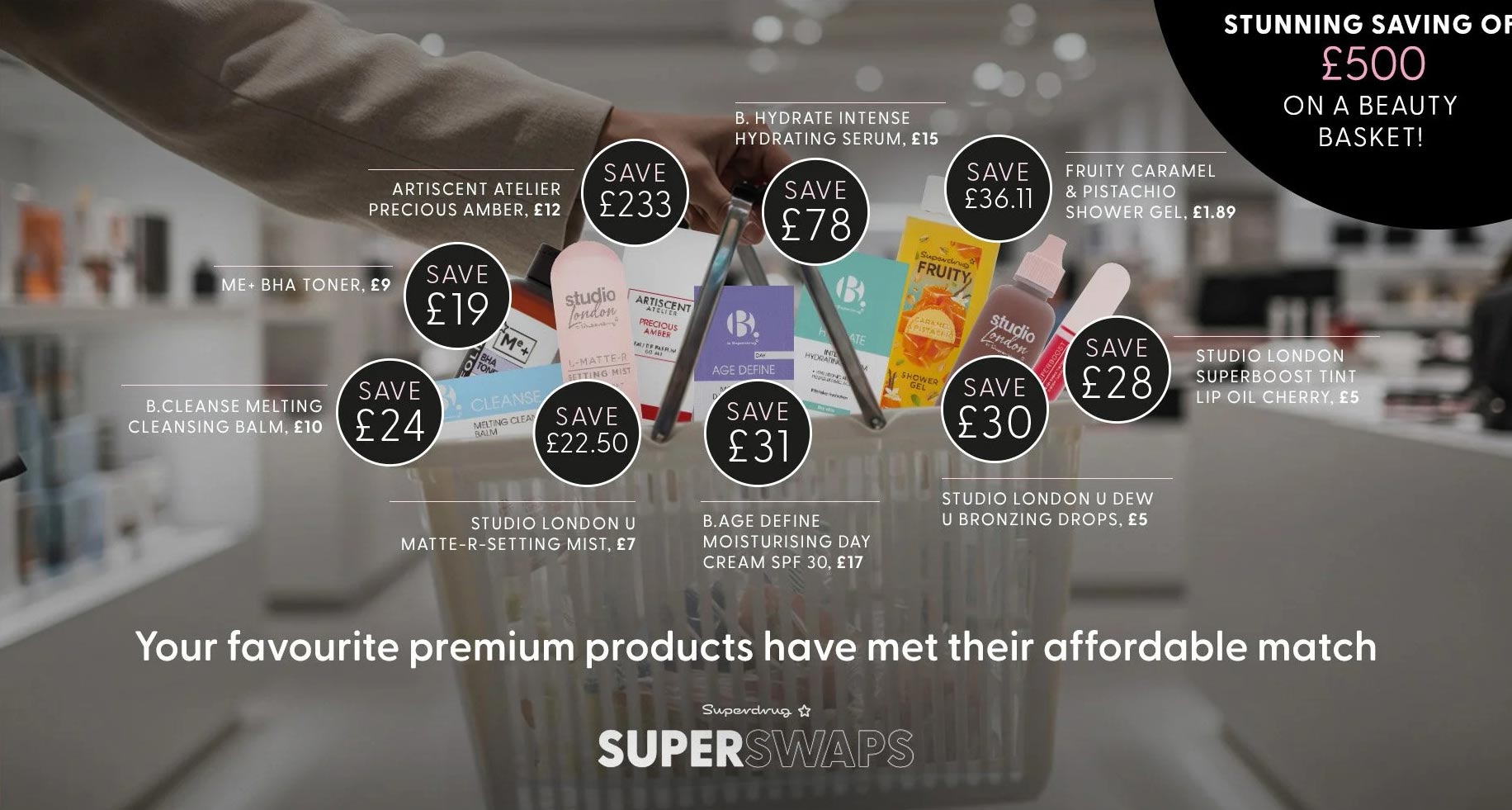
Superdrug’s own-brand ranges in its 2025 SuperSwaps campaign. Image: Superdrug
Not every brand agrees. Makeup brand founder Charlotte Tilbury has pushed back on dupe culture more than once. In a BBC interview in July 2026, she argued “when you dupe, you dupe the consumer,” stating that in her opinion, dupes don’t match the quality or performance of the original. The comments, dubbed “Charlotte Gate” on social media, split opinion through the summer, and demonstrate that dupe culture has gained enough ground to draw a public response from one of beauty’s biggest names.
Own-brand doesn’t always settle for a corner of the market, sometimes it takes the lead. Parents are famously risk-averse when it comes to anything touching their baby, yet Aldi says Mamia is the largest own-label nappy and pants brand in Great Britain, with more than one in five sold [18]. Its quality has been independently recognised too, winning Silver for Best Performance Disposable Nappy at the Mother&Baby Awards 2025. Aldi says it’s still innovating the product, adding technology it claims is exclusive to the range [19].
No7 is one of retail’s clearest examples of an own-brand that’s outgrown its shelf to become a business of its own. It started life as Boots’ in-house skincare range, and the retailer now calls it the UK’s number one skincare brand. In 2021, it was formally established as No7 Beauty Company, a deliberate move to position it as a genuine beauty business rather than a private label, and to push global expansion, particularly in North America.
In the US, Boots have a different strategy for a different set of customers. There’s no existing brand loyalty to the Boots master brand to draw on, so No7 set about earning its own instead. It launched into Target more than 20 years ago with no Boots branding, and it’s still there today. In January 2025, it brought an immersive experience straight to consumers: a double-decker bus fitted out with skin scans and dermatologist consultations, touring Walgreens stores across the US to launch Derm Solutions, No7’s entry into the healthy skin category in North America [20].
The same instinct runs through every case study in this paper: know who’s actually buying, and build for them, not for what’s convenient to say about the parent brand. The reputation and quality were already built, and that’s what let No7 stand on its own in the US, no Boots name to lean on, just the brand itself.
Food & drink
If a shopper trusts an own-brand tin of beans without a second thought, that’s not a discount decision, it’s a new kind of brand loyalty. It shows up most in canned and dry goods (31%), breakfast and bakery (31%) and dairy (28%) [21], the categories bought on repeat and restocked without too much thought. Exactly where that kind of unthinking trust actually gets tested.
This September, Amazon launched billboards and posters across Greater London under the tagline “Amazown label,” promoting byAmazon, its own-label grocery range, timed to coincide with the launch of same-day fresh grocery delivery in the capital.
It’s the first time Amazon has “allowed their brand name to be usurped in service of an individual product”, according to Matt Davis, owner and Executive Creative Director at creative agency Red Brick Road. The bet was that own-brand has become a language shoppers already trust, enough to build a campaign around.
Laura Harris, Amazon’s Head of Brand and Marketing for grocery private brands, explained the thinking:
How do you build awareness for a brand most people don’t know exists, inside one of the most recognised brands on Earth? You borrow a language everyone already understands.
However, not every food category has seen the switch. Branded still leads own-brand in alcohol (50% mainly branded), pet food (39%) and baby food products (37%) [22], with alcohol showing the widest gap of the three. These are categories where own-brand hasn’t caught up yet, not where it’s failed.
Even in alcohol, own-brand can still turn a dupe into an opportunity. In 2020, Aldi launched an own-brand IPA, “Anti Establishment”, whose can closely echoed BrewDog’s Punk IPA. Rather than a legal battle, the two brands turned it into a joke on Twitter with BrewDog threatening to make a fake Aldi beer in reply. Aldi’s buying director said customer enquiries surged [23], and it became a genuine collaboration: “ALD IPA,” made by BrewDog, reached Aldi’s shelves that October [24].
Home & interiors
42% of shoppers mainly buy own-brand everyday household products, the highest of any category Simon-Kucher measured [25]. In the US, own-brand holds 32.5% of the home and garden sector [26], and in the UK, Dunelm holds 7.9% of homewares with a largely own-brand range [27]. In our view, the draw is becoming desirability, not just price.
George is Asda’s own-brand label, with George Home its dedicated homeware sub-brand. It now has a standalone concept store, trialled in Leeds from May 2025, selling clothing alongside George Home. In August 2026 it launched one of its biggest campaigns in recent years, “If You Know, You Know”, created by agency Lucky Generals, positioning George as a credible destination for style without compromising on value [28].
Out-of-home ads use oversized typography to frame individual homeware pieces as the season’s hidden gems, with lines like “The vase everyone’s after” [29]. It’s the language of desirability, not discount.
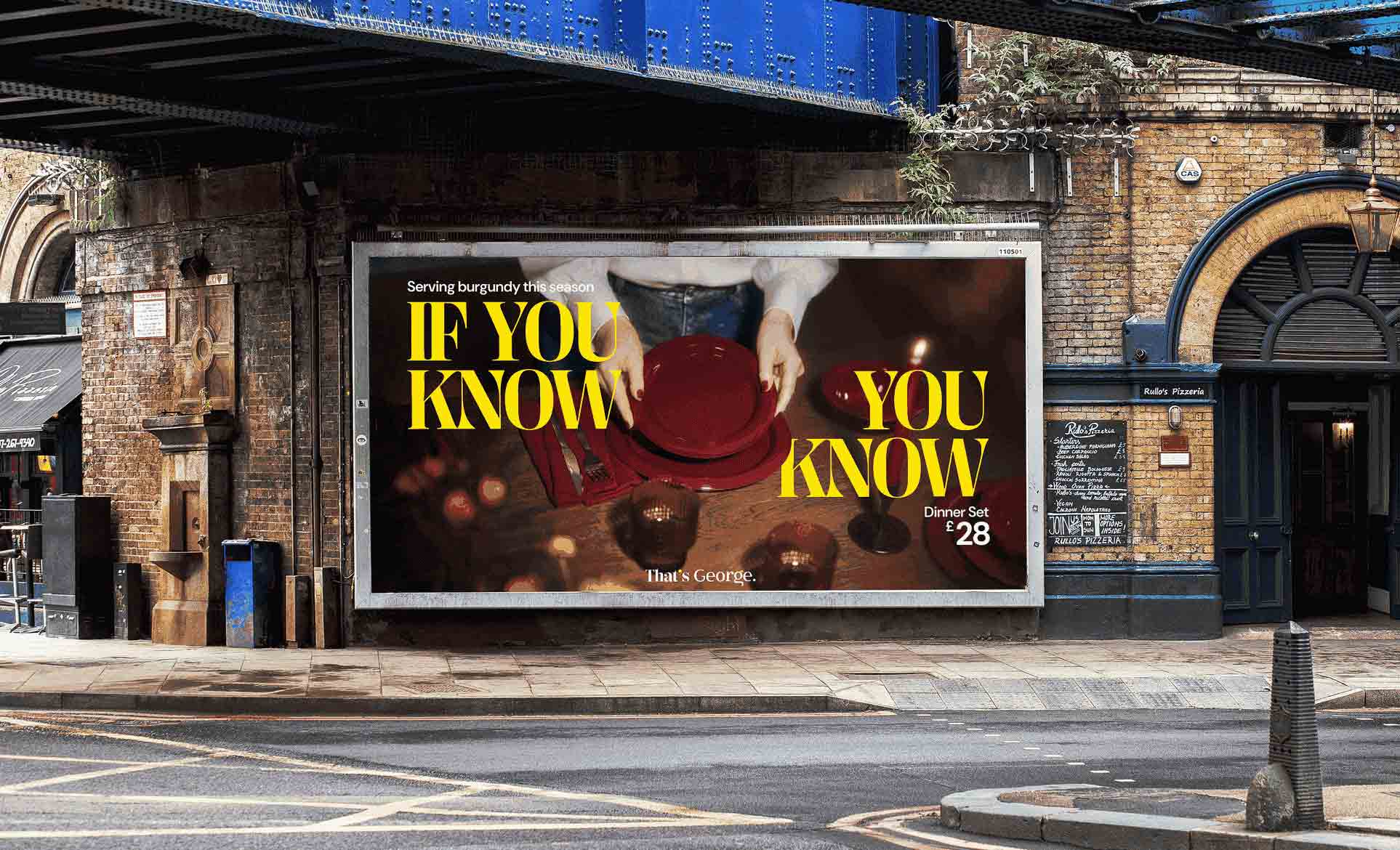
Image: George at Asda, “If You Know, You Know” campaign by Lucky Generals
George Home’s partnership with Stacey Solomon was a strategic one, giving her the job of designing the range rather than simply fronting it. The launch positions George Home as a key destination in home interiors, with a partner it knew resonated with its customers [30]. One agency planner notes that her fanbase is made up of home-décor fans and parents of young children, which reads almost like a description of George Home’s target audience [31].
When her spring/summer collection launched in 2024, Asda reported homewares sales up 11.7% in the first quarter, which it said the launch had boosted [32]. She has since returned with new spring/summer collections, most recently SS26. In our view, the range now behaves less like an influencer campaign and more like a product line.
Social media can turn an own-brand range into a treasure hunt, and shoppers into its marketing team. At Home Bargains, TikTok users film themselves searching the shelves for the Bear’s Bakery plush toys and bedding, and urge each other to get there before they sell out [33]. The range is widely called a Jellycat dupe, and posts featuring the alleged dupes have drawn millions of views, many carrying Jellycat’s own hashtag, which has more than 700,000 posts. Jellycat has since filed a copyright claim against Home Bargains’ parent company, TJ Morris, over alleged copies of its plush toys [34].
Ride Shotgun in practice: Pets at Home, Asda and Holland & Barrett
We’ve built own-brand ranges from the ground up, taken existing ones further, and helped retailers decide when an own-brand should lean on the parent name and when it should stand entirely on its own.
Lucy Folkes, Ride Shotgun’s Group Client Director, has spent years helping retailers navigate exactly this shift: “In an increasingly competitive market, own-brands give businesses the opportunity to shape their own story and build loyalty.”
Pets at Home
Ride Shotgun has worked with Pets at Home for a number of years, building deep category and customer understanding across their business. Wildways began life as a basic own-label dog food range, and the brief was to build it into a brand owners would choose, believe in and remember.
We started with the customer, not the product: how do you help owners who hold themselves to a higher standard feed their dogs the way they believe nature intended? The insight behind it: modern pet food has done to dogs’ diets what ultra-processed food has done to ours, convenience over what nature intended.
From that insight, we built the strategic proposition: Wildways exists to reclaim what modern pet food sacrificed, the ancestral diet of the wild. We positioned it as the mid-tier step-up, natural cues, high meat, grain-free, clean labels, for owners trading up from value but not ready to pay premium prices. Then we turned that conviction into a full brand: mission, purpose, values and manifesto, a creative platform, “Feed Their Instincts,” carried consistently across web, social, CRM and in-store.
Wildways demonstrates what trust makes possible: the confidence to hand over a brand from the ground up, not just a range refresh.

Discover how we join up the Pets at Home brand journey.
Transforming the retail brand experience in three months, changing perception at scale.
Pets at Home case studyAsda
Asda’s recurring challenge was to make own-brand an easy choice for shoppers, whatever the category or price tier: reassuring existing customers on quality, retaining their loyalty, and giving shoppers switching from national brands a reason to choose Asda with confidence.
Ride Shotgun’s long-standing relationship with Asda across grocery and home has given us a deep understanding of its categories and the role packaging plays in building that confidence. Our approach is to create a joined-up own-brand system that can flex to the needs of different categories while remaining recognisably Asda.
Rather than designing individual products in isolation, we developed packaging at range level, creating clear navigation and a coherent visual language that helps shoppers make fast, confident decisions at shelf.
In canned fruit and vegetables, for example, photography, product-specific pattern and a circular information device combine within Asda’s mid-tier toolkit to make quality feel tangible, while in fresh juice the same strategic thinking creates a flexible system capable of working across 34-plus products and sub-categories without losing consistency.
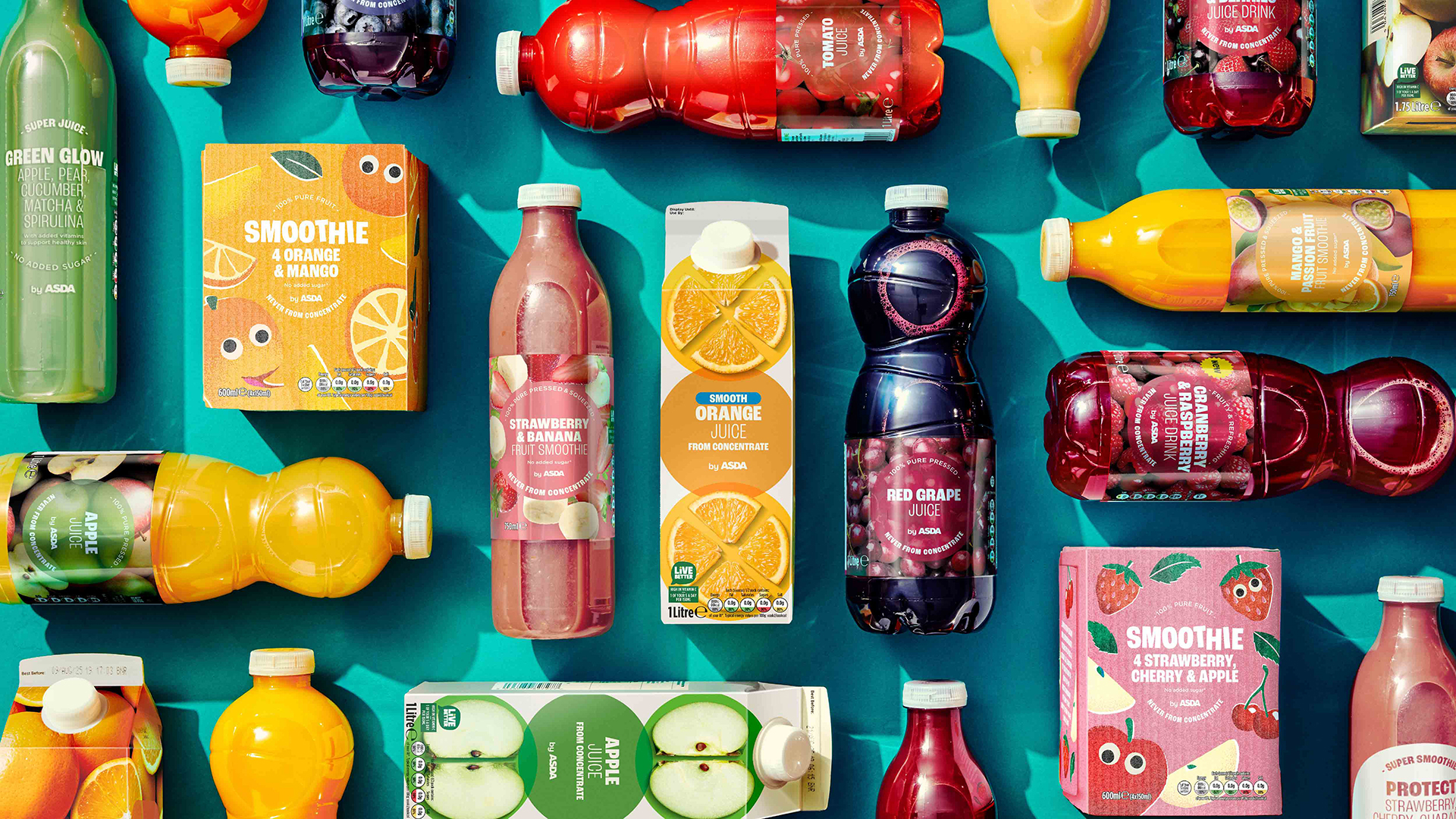
Asda fresh juice range, packaging by Ride Shotgun.
Holland & Barrett
We partnered with Holland & Barrett to reclaim its heritage in own-label nutrition for a new generation of health-conscious consumers. The strategic challenge was to change perceptions of own-brand health food: proving their products could deliver on taste as well as nutritional benefit, while giving shoppers a genuine reason to make Holland & Barrett part of their regular food shop.
Over 300 new own-brand products followed, from functional teas to specialist flours, the biggest shake-up of Holland & Barrett’s food category to date. Customer insight sat at the heart of it: the range combined accessible health benefits with genuine product innovation, including a number of first-to-market moments.
Our role was to translate that transformation into a reason for shoppers to reconsider Holland & Barrett as a destination for great-tasting, benefit-led food, not just supplements. We developed the strategic platform behind the launch, positioning the revitalised range at the intersection of taste, health and everyday enjoyment, then built the creative idea to carry it: “Food that loves you back.”
Holland & Barrett backed the campaign properly: £5m in media investment across OOH, press, social and paid digital, plus a full in-store takeover, connecting brand communications with the physical shopping experience. A real, planned investment behind an own-brand range, not what’s left once the master brand’s budget is decided.

Find out more about our wider strategic and creative partnership with Holland & Barrett.
Driving awareness and consideration to revive the relevance of a wellness icon.
Holland & Barrett case studyWhat it means for marketers, and the questions worth asking
Own-brand leans on the master brand more than it might seem. Would M&S’s Apothecary Warmth Eau de Parfum hold its own next to the prestige names on the shelf without M&S’s marketing behind it? Probably not on its own. Shoppers who already trust a retailer for one thing are more likely to trust its own-brand in another, from fragrance to food to homeware.
So if the master brand’s name is already doing half the work, why does own-brand still get treated like the half that doesn’t matter?
- A brand strategy of its own, or someone else’s afterthought? Own-brand touches everything from pricing and packaging to social and in-store. Run each part separately and it ends up inconsistent. Run it as one strategy and you get something like Lidl’s Deluxe: a premium name shoppers now trade up to at Christmas, from macarons to panettone. Is your own-brand joined up, or are pricing, packaging and marketing each making their own calls?
- Is own-brand getting the leftover budget? It can lose out to the master brand, not because the range is underperforming, but because there’s less internal pressure to protect it. Waitrose did the opposite: as sales of its premium No.1 range grew, it gave the range its own campaign, fronted by Chesney Hawkes, a man who knows a thing or two about being the one and only. If your own-brand already pays its way, does its marketing budget reflect that?
- A success story, or a well-kept secret? No7 didn’t stay just another range on Boots’ shelves. It became a category-leading global company in its own right. A product that stands on its own two feet doesn’t need less marketing. It needs conviction rather than caution. Is your own-brand being treated as a brand in its own right, or is it still waiting for permission?
- Under the master brand, or a name of its own? Tesco runs some of its ranges as venture brands, which don’t carry the Tesco name at all. Others, like Tesco Finest, sit firmly under the master brand. Is your own-brand’s name a deliberate choice, or just the default?
- A voice of its own, or just a label on a pack? M&S gave Percy Pig an Instagram account with a personality to match, and even a merchandise range. It now has a following of over 100,000. Does your own-brand have a voice like that?
- Look at how others are innovating, not just what they’re spending. No7 led its category by developing a product 15 years in the making. Holland & Barrett put “Plant Points” on pack, a first for a UK high-street retailer. None of that came from a bigger budget alone, it came from ambition. Where’s the innovation in your own-brand?
From own-brand to known-brand
Own-brand has earned shoppers’ trust, their loyalty and, more and more, their attention. The retailers getting ahead are the ones treating it like the brand it already is: giving it a strategy, a budget and a voice of its own.
The next step is innovation, in the product and in how it reaches shoppers: packaging that holds its own next to the big names, campaigns with real personality, and ideas that move the category forward. It’s the work we do with retailers every day, and it’s where own-brand gets interesting.
The challenge for marketers is how they harness changing consumer expectations, move beyond responding to market trends and lead through innovation. Own-brands offer the potential to shape the future of retail, setting the standard for the industry rather than following it.
Lucy Folkes, Group Client Director | Ride Shotgun
Let’s talk own-brand
If your own-brand needs the same thinking a national brand would get, we’re a conversation away.
Contact UsSources
-
1.
Simon-Kucher, Global Shopper Study 2026, 14,000 consumers, 14 markets, fieldwork January 2026
-
2.
Simon-Kucher, Global Shopper Study 2026
-
3.
Simon-Kucher, Global Shopper Study 2026
-
4.
NZTE, Private Label F&B Opportunities in the UK, December 2025, citing McKinsey, 2024
-
5.
McKinsey, private label share of grocery retail in European countries, 2024, cited in NZTE
-
6.
Simon-Kucher, Global Shopper Study 2026
-
7.
Numerator, Private Label’s Next Power Players: Gen Z, June 2025 (US)
-
8.
NIQ and World Data Lab, A Tale of Two Consumers, August 2026 (multi-market, including the UK)
-
9.
First Insight, via The Food Institute, April 2026 (US)
-
10.
NUEX Creative, “The Biggest Branding Mistakes CPG Brands Made in 2025 (and How to Avoid Them in 2026)” 14 Feb 2026
-
11.
Deloitte, Q3 2025 Emerging Retail and Consumer Trends (US)
-
12.
Ride Shotgun, proprietary AI research tool, Reddit analysis of 866 UK-focused posts, August 2026
-
13.
Circana, Eat, Play, Love, quoted in Cosmetics Business, July 2025
-
14.
Numerator, sector shares, via Supermarket News, August 2024 (US)
-
15.
Simon-Kucher, Global Shopper Study 2026
-
16.
Circana, Life Imitates Brands: How Dupe Demand is Evolving, August 2026 (US)
-
17.
Mintel, UK Prestige Beauty Consumer, 2024
-
18.
Aldi UK Press Office, “Aldi is the golden brand for new parents”, April 2024
-
19.
Aldi, Mamia product information, 2025
-
20.
PRNewswire, “No7 kicks off Skin Rehab Tour in partnership with Walgreens”, January 2025
-
21.
Simon-Kucher, Global Shopper Study 2026
-
22.
Simon-Kucher, Global Shopper Study 2026
-
23.
Grampian Online, Collaboration between Brewdog and supermarket to help environment, October 2020
-
24.
Press and Journal, “BrewDog and Aldi call time on Twitter spat with new beer collaboration”, October 2020
-
25.
Simon-Kucher, Global Shopper Study 2026
-
26.
Numerator, sector shares, via Supermarket News, August 2024 (US)
-
27.
Dunelm Group, corporate disclosures, 2026 (company-reported)
-
28.
Asda, “George gives shoppers the inside track on the best value stylish homeware and fashion with new ‘If You Know, You Know’ campaign platform” August 2026
-
29.
Asda, ‘If You Know, You Know’ campaign platform” August 2026
-
30.
Asda, “George Home at Asda announces exclusive partnership with Stacey Solomon”, 16 August 2023
-
31.
The Drum, “Stacey Solomon and George Home is a strategic partnership made in heaven”, Ellie Cordy, Don’t be Shy, 25 June 2024
-
32.
Asda, Q1 2024 trading update, May 2024
-
33.
TikTok, shopper posts, June 2026
-
34.
Scottish Legal News, “Jellycat sues Home Bargains owner over alleged copycat toys”, 3 September 2026 (reports a City AM story, 2 September 2026)
